

Are We Authentic?
It has often been said that education is an act of love – and in a world facing growing instability and deepening crises with unprecedented plunging funding for the weakest left furthest behind, that truth has never felt more urgent or more real.
Education is hope amid conflict, opportunity in the shadow of despair and the strongest foundation for peace, prosperity and resilience. If we truly feel empathy, we become unstoppable in our quest to serve children and adolescents who need us more than ever.
There is, though, one human imperative that is above love. That is authenticity. When we are authentic, we instinctively and reflexively care for others. We instantly put the 234 million children in armed conflict, forced displacement and climate-induced disasters at the forefront of our authentic truth. It becomes our mission in life. This is what makes us more than just human. It makes us humane.
As we embrace the UN80 Initiative and reimagine multilateralism for a new era, Education Cannot Wait (ECW) and our strategic partners are building a value proposition that speaks to both the heart and the mind. It demands from us to transcend ourselves for others. This is what service is all about.
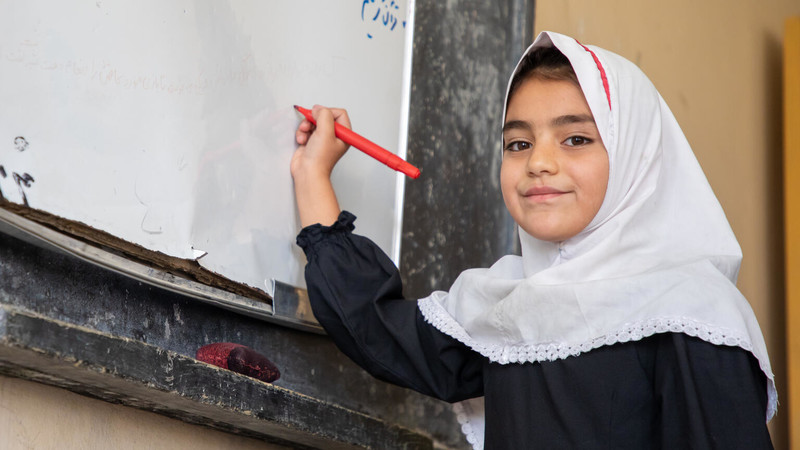
To the heart, our message is clear: in a fast-changing world, we must keep hope alive for the millions of crisis-impacted children and youth that so urgently need the safety, hope and opportunity that a quality education provides. Without us, they will never realize their potentials, never have a chance to transmute their resilience into a powerful force of good for all humanity. These children and adolescents, whom I have met during my numerous travels and many duty-stations in their countries, are potential alchemists. They can turn pain into humanity, if they are just given an opportunity through education. Do we want to lose the strength of nearly a quarter of a billion children and youth or just let it slip away?
Our value proposition is simple. An inclusive and sustainable quality education is the key to greatness for children and youth suffering in the most terrible conditions, such as violent conflicts, forced to flee their homes or suddenly having their lives turned upside-down due to a climate-induced disaster.
While it is also good for business, economic growth and national stability, I know with absolute certainty that the private sector also cares for humanity, not just in emerging markets. It comes with their drive to be authentic. The same applies for the public sector wanting to make the world a better place.
We all know that on the frontlines of the world’s most dire humanitarian crises – in places like eastern Democratic Republic of the Congo, Gaza, Sudan and beyond – education is the only hope left for millions enduring or at risk of unimaginable horrors.
In June, as we marked the International Day of Refugees, we reaffirmed our commitment to the millions of forcibly displaced children and youth worldwide, each one deserving of the protection, dignity and future that education can offer. Being a refugee is the most painful experience a young child can have. They have to flee their home country, which they love, to seek protection across an international border. They carry with them enormous trauma having seen their villages burnt to the ground, their parents killed, the loss of their friends and all that once was their safety and familiar daily life.
The cost of inaction is immeasurable. Without quality education for all, a key foundation of both the Sustainable Development Goals and the Pact for the Future, we risk a surge in human rights violations such as forced recruitment into armed groups, human trafficking, child marriage and child labour. We risk losing even more innocent lives in senseless wars. We risk rising displacement as families flee in search of safety and opportunity. And we risk a loss of their potential because the linkage between climate change and their lives seems so abstract to many, while, in fact, it is very real.
It takes authenticity to see the naked truth for what it is and fearlessly speak that truth to power. We have a chance now to turn around the devastating downfall in international development assistance and rally the private sector to join our shared mission. We must and we can. It will serve us all.
Evidence to support this is undeniable. According to recent data from multiple sources and shared by the Global Education Cluster: “Education accounts for 50% of global economic growth, 70% of income gains among the world’s poorest quintile and 40% of extreme poverty reduction since 1980 (Gethin 2024). Every US$1 a government spends on education increases GDP on average by US$20.36 (World Bank 2022). Foundational learning could lead to higher productivity and double the GDP per capita in sub-Saharan Africa by 2050 (World Bank Africa Pulse 2024).”
Since ECW became operational in 2017, we’ve embraced UN reform as a lean, agile and responsive pooled funding mechanism that delivers results with impact, transparency and fidelity. Our investments have already reached nearly 12 million children and youth. With more funds, we can reach 100 million, even 200 million. The coordination mechanisms are in place. The implementers (host governments, civil society, local communities and UN agencies) are ready on the ground. All they need is the financing.
As a catalytic fund, ECW is here to speak up for all. For the 234 million children and adolescents calling for us to give them a quality education. We are also here to speak up for all our partners in-country to help them do their job.
We will keep speaking truth to power. For their sake and for the sake of all of us. This is our shared mission. We need to tune in and listen to their voices. They need us to be intellectually honest, courageous leaders and unapologetically committed to them. Indeed, they deserve no less.
Tweets
Additional Statements and Updates