

Joint Statement by UNICEF Representative to Myanmar, Marcoluigi Corsi, and Education Cannot Wait Executive Director, Yasmine Sherif, on urgent need to scale-up humanitarian funding for Myanmar through innovative education initiatives
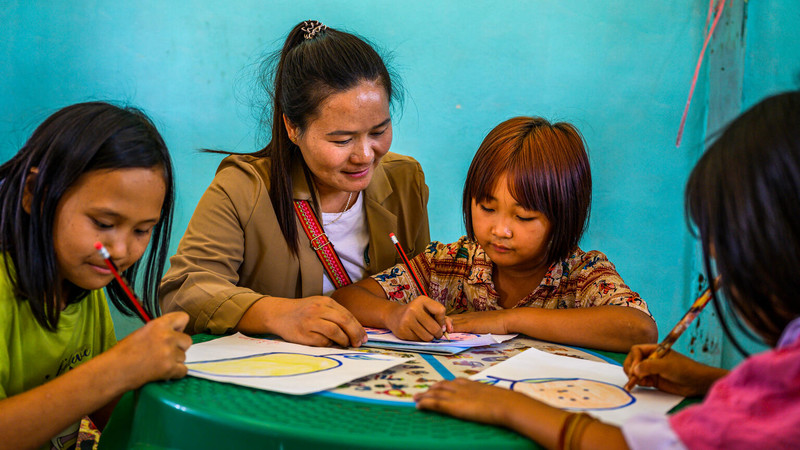
As communities across central Myanmar grapple with the aftermath of the devastating 7.7 magnitude earthquake of 28 March, the needs remain immense – particularly for children, who continue to bear the heaviest burden. Homes, schools and essential services have been damaged or destroyed, disrupting children’s learning and safety.
Urgent funding is needed to scale up life-saving humanitarian support, including access to safe, protective, community-based learning for the nearly 2 million children in the affected areas – and to help begin the long road to recovery.
The earthquake is one of multiple, overlapping crises affecting children and families in Myanmar. Escalating conflict, economic hardship and mass displacement continue to erode access to essential services like education. Over 3.6 million people are currently displaced across the country, including both newly displaced populations since the 2021 military takeover and those in protracted situations, including Rohingya communities. More than 30% of them are children, many without access to safe learning, protection or basic services.
Amid these compounding challenges, the need to protect children’s rights to survival, learning and protection remains urgent and non-negotiable. The global community has the resources – and the responsibility – to act.
Education Cannot Wait (ECW) and its partners are helping to meet this imperative through community-based, remote and inclusive learning initiatives. Through ECW’s US$19 million Multi-Year Resilience Programme, more than 73,000 children, over half of them girls, have already been reached with safe and flexible learning opportunities.
Innovative solutions are being scaled up: new learning spaces, cash assistance to support school attendance, mental health and psychosocial support, and tailored learning tools and training for teachers and communities in hard-to-reach and conflict-affected areas. These efforts are not only restoring access to learning, but also delivering protection, stability and hope for the future.
Even before the earthquake, over 6.5 million children were in need of humanitarian assistance. Yet, the humanitarian response remains critically underfunded, with only about 10% of the 2025 Humanitarian Action for Children appeal received to date.
Humanitarian partners remain deeply concerned about the widespread and growing impact of hostilities on children, with homes, schools and healthcare facilities increasingly coming under attack. Such violence against civilians and civilian infrastructure is unacceptable and must end.
In the face of ongoing crisis, humanitarian action must remain anchored in the principles of humanity, neutrality, impartiality and independence. Assistance must be based solely on needs, with priority given to the most vulnerable – especially children.
The children of Myanmar have a right to education – and in times of crisis, education is a lifeline. It provides protection, stability and tools to rebuild lives. Upholding humanitarian principles is not only a legal and moral obligation – it is the way forward.
Tweets
Additional Statements and Updates