

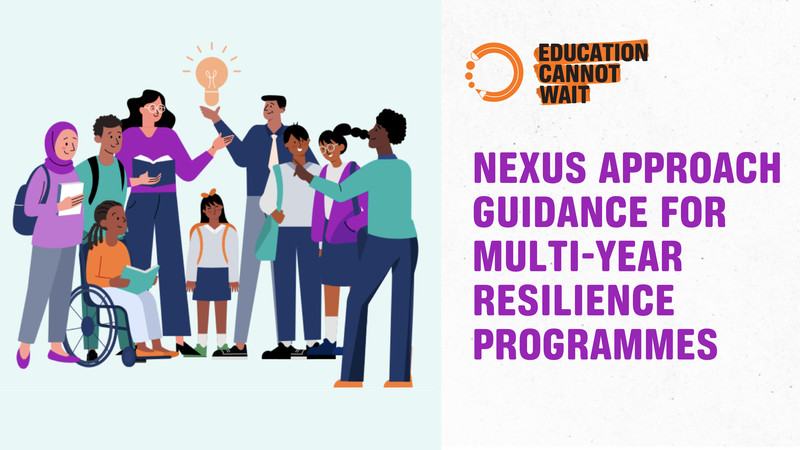
Education Cannot Wait Launches Nexus Approach Guidance for Multi-Year Resilience Programmes
In a world where conflicts, forced displacement, climate-induced disasters and protracted crises are on the rise while aid budgets and funding are declining, the need for more coherent, cross-sectoral approaches to humanitarian assistance, development and peacebuilding is more urgent than ever.
In this context, Education Cannot Wait (ECW)’s newly released Nexus Approach Guidance for Multi-Year Resilience Programmes comes as a much needed tool to assist practitioners and government stakeholders in designing education in emergencies and protracted crises (EiEPC) responses that effectively work across the humanitarian-development-peace nexus, or the ‘triple nexus’.
Grounded in the independent evaluation of ECW's Multi-Year Resilience Programmes (MYRPs) which identified opportunities to strengthen the nexus approach in EiEPC responses through clearer guidance and support for multi-year programmes, this guidance was developed over the course of 2024, drawing on best practices from various contexts.
Education in Emergencies: A Cross-Cutting Priority
Education is not only a right, but also a crucial foundation to achieve progress on all Sustainable Development Goals. During crises, education is also key to protecting and safeguarding the well-being of children and to supporting recovery and resilience. Despite this critical role, in crisis contexts, education is among the first services to be disrupted, putting at risk the present and future of entire generations of children and adolescents. Governments, already stretched thin in normal times, often cannot meet education needs in emergencies, leaving gaps in services. External aid can play a critical role in filling education gaps, supporting governments to provide quality education even in the most difficult contexts.
Despite the cross-cutting relevance of education (for poverty reduction, peace, and climate resilience, for example), EiEPC efforts can fail to fully leverage a coherent, coordinated approach. Yet, coherence across humanitarian, development and peacebuilding actions is essential for delivering and scaling education services more effectively and efficiently in fragile contexts. With growing needs against a backdrop of declining aid budgets, working collaboratively is more essential than ever if we are to meet the educational needs of 234 million crisis-affected children.
Refining ECW’s Nexus Approach
ECW’s MYRPs, which provide multi-year education responses in protracted crisis settings, have long included a focus on working across humanitarian and development systems and actors. To further build on this work, ECW developed a framework to clearly define how MYRPs can better promote coordination across the triple nexus in the diverse contexts in which they operate.
Drawing on common themes from international frameworks on aid coordination like those of OECD-DAC, IASC and OCHA’s New Way of Working, ECW outlined four critical areas of engagement for education partners:
- Joint planning and programming: Strengthening collaboration across actors during programme design, assessments and implementation.
- Aligned funding and resource mobilization: Coordinating to mobilize needed funding for EiEPC gaps.
- Coordinated data and evidence: Enhancing the generation, use and sharing of crisis data to inform education planning and responses.
- Localization: Empowering local actors and communities to play a meaningful, lead role in responding to crises.
These four pillars represent entry points for greater collaboration, ensuring more sustainable and scalable outcomes in EiEPC responses.
From Theory to Practice
Building on this framework, ECW created a practical guide to help embed this nexus approach into the design and implementation of MYRPs. The guide, which supplements ECW’s MYRP Manual, offers step-by-step instructions on how to incorporate actions during every stage of programme development to enhance collaboration and reduce fragmentation, while strengthening education systems. The guide has been tested in countries like Nigeria, Chad and the Democratic Republic of Congo, and refined based on lessons learned.
By defining what nexus-responsive programming looks like in practice and drawing on the principles of the Paris Declaration on Aid Effectiveness, the guidance describes ways that MYRPs can realize aid effectiveness outcomes in EiEPC.
Examples of outcomes that result from improved coordination across the nexus:
Aligned approaches: Developing or leveraging plans, frameworks, standards and implementation modalities that support coherence in programme outcomes. For example, in developing a teacher development training to improve quality education in crisis contexts, the programme aligns with existing national certification frameworks.
Harmonized responses: Interventions that complement and build-on other efforts working towards the same outcome. For example, if other actors/programmes are working on rehabilitating or building education infrastructure in a crisis context, the programme may focus on supporting recruitment and training teachers in the same schools to improve access to quality education.
Local ownership: Supporting local and national partners to exercise effective leadership in the achievement of the MYRP priorities. For example, working closely with community-based School Management Committees to hand over management and maintenance of schools rehabilitated by the programme to ensure continued access and sustainability.
Emerging Insights and Future Directions
As part of this work on strengthening the nexus, ECW has begun a formative evaluation to assess progress and learn from the work of our implementing partners. As ECW continues to implement its refined nexus approach, we remain committed to documenting lessons learned and sharing these insights with the broader EiEPC community – fostering deeper reflections aimed at improving impact across the education sector.
By continuing to build stronger connections between humanitarian, development and peace efforts, ECW aims to catalyze human-centered responses that maximize aid efficiency, value for money, and impact for the future of children and adolescents in crisis contexts.
For any questions or feedback, contact Beza Tesfaye, betesfaye@un-ecw.org.
More featured content