

“Education Is the Single Most Powerful Tool to Protect Children in Crisis”
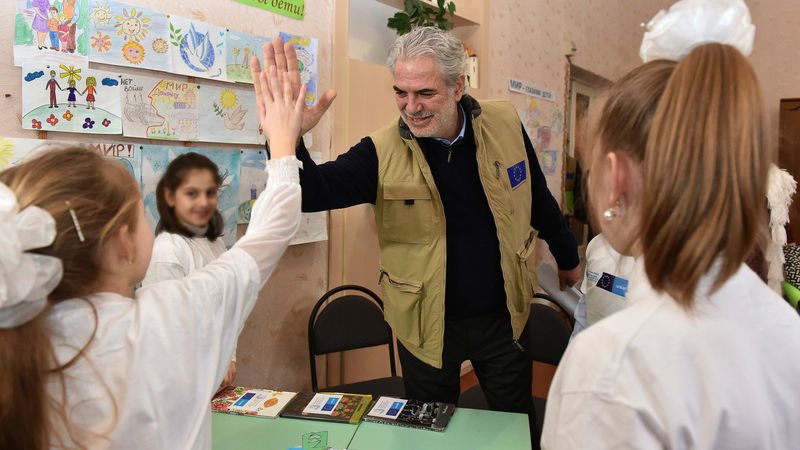
In the new Leaders Series, Education Cannot Wait introduces you to those who have been tireless advocates and champions of the fund and its work.
In March, EU Commissioner for Humanitarian Aid and Crisis Management Christos Stylianides spoke to us about his determination to provide education for all crisis-affected children.
In 2016, there was an extraordinary effort to galvanize the political will and resources needed to transform education in emergencies. How can we build on that?
Indeed, 2016 was rather extraordinary. It feels like, after speaking about education as a basic need in conflicts and disasters for so long, we are finally making headway. I saw unprecedented political will and dynamism that led for example to the launch of ‘Education Cannot Wait (ECW)’ at the World Humanitarian Summit. And 2016 was also the year the EU decided to change our traditional ‘external’ understanding of humanitarian aid and to bring forward new funding and legislation to support access to quality education to the children recently arrived as refugees and irregular migrants in Greece. Extraordinary times require extraordinary measures.
But there is still so much to do. We need to mobilise more resources, widen the donor community and improve coordination and complementarity between funds. It’s time to really ensure a seamless transition from emergency response to development, and vice versa. We also need better and more efficient data and evidence, so that we are genuinely learning the lessons of the past to make sure we spend every euro wisely. The momentum is there, and we cannot sit back now.
In the context of a large number of competing priorities and a complex political environment in Europe, how have you managed to prioritize education in emergencies?
Spending more on education in emergencies in the current context of growing humanitarian needs and budgetary constraints has not been easy. Prioritisation in humanitarian aid is extremely difficult; however, we are moving towards a more holistic and integrated approach to handle the challenges. Our close partnership with Members of the European Parliament and EU Member States who share this vision was instrumental in securing a budget increase for education in emergencies last year. One of the lessons learned for me was the importance of tireless advocacy and outreach to build a gradual consensus on a new policy agenda.
Since the beginning of my mandate I have been a tireless advocate of education in emergencies and have progressively scaled up EU’s humanitarian funding, first from 1% to 4%, and now to 6% of our annual humanitarian aid budget. In fact, the EU is currently one of the world’s largest donors of humanitarian and development assistance for education.
As one of the world’s largest donors to education in emergencies, how would you make the case to other donors to follow your lead and invest?
Ensuring that the most vulnerable children – many of whom live in conflict-affected countries or have been forcibly displaced – have access to school is the key to making sure we don’t leave a lost generation behind. These children cannot wait until some long term reconstruction plan is put in place post emergency. We need to maintain the continuum of their education to build the resilience of their communities. This is what will enable and speed up the potential recovery from the trauma of the conflict or disaster they have been through.
In February 2017, leaders gathered in Oslo to pledge their support for children living in Nigeria & the Lake Chad Basin- what is the role of education in finding a lasting solution to this crisis?
The Lake Chad region is clearly an area where the international community must do much more to avert a humanitarian catastrophe. Many years of neglect, marginalisation, as well as violence and insecurity have wreaked havoc and destroyed the livelihoods and lives of so many. The Oslo Conference was a more than timely recognition of this. The EU pledged to mobilise EUR 105 million for the region in 2017 to face the huge unmet needs.
Students and their teachers have endured countless attacks and interruptions in the region. Investing in education is investing in peace, in long-term societal resilience, in development and economic growth, in our future and that of coming generations.
As part of our support, we dedicated EUR 4 million already in 2015 to provide quality learning in safe and secure environments in the Lake Chad region. I am pleased to see that Chad is actually one of the countries that will benefit of the initial investments by Education Cannot Wait. I hope that our common efforts will support children and help scale up the capacities for much needed stronger education response in the region.
You’ve met with many children who are overcoming enormous obstacles to stay in school and learn in the world’s toughest environments- what have you heard from them and how have they inspired you?
Every time I travel to crisis areas and visit those suffering the consequences of conflicts or natural disasters, I make a point of meeting with children, youths, their parents and teachers. I spend time with them to hear about their lives and concerns, their hopes and dreams.
Since my earliest encounters with beneficiaries as EU Commissioner for Humanitarian Aid and Crisis Management, education has been a recurrent theme. I still remember the day in the Bekaa Valley, in Lebanon, when I talked with a Syrian mother. She thanked me for the EU aid but was quite blunt that just any kind of aid was not enough. It had to come hand in hand with hope and prospects for her children, which only education could bring. And of course she was right.
Whenever I speak to children who have the chance to continue studying despite their circumstances, I am amazed by how resilient and positive they are. I truly believe that education is the single most powerful tool that can protect, sustain and support children, not only in the midst of a crisis but also when the situation improves.
I believe that engaging directly and listening to what they have to say is the best way to understand what they really need. During my visits, many children going through unspeakable hardship and tragedy have shared with me their aspirations. Some want to become doctors, others teachers. They want to be able to study to ensure their own futures, to help others and, in the longer term, to rebuild their countries. This is an inspiring message that we would be extremely foolish to ignore.
More featured content