


Getting Ahead of the Flood: How Education Cannot Wait Investments in Anticipatory Action Is Keeping Pakistan’s Children Learning
By Anfal Saqib, ECW First Emergency Response Manager, and Ehsan Ullah, Education Officer, UNICEF Pakistan
As this year’s 10th Global Dialogue Platform on Anticipatory Action begins in Berlin, Education Cannot Wait (ECW) shares how pioneering work on Anticipatory Action in education in emergencies contexts is helping to shape an early action mindset and minimize impacts of climate hazards on children’s learning.
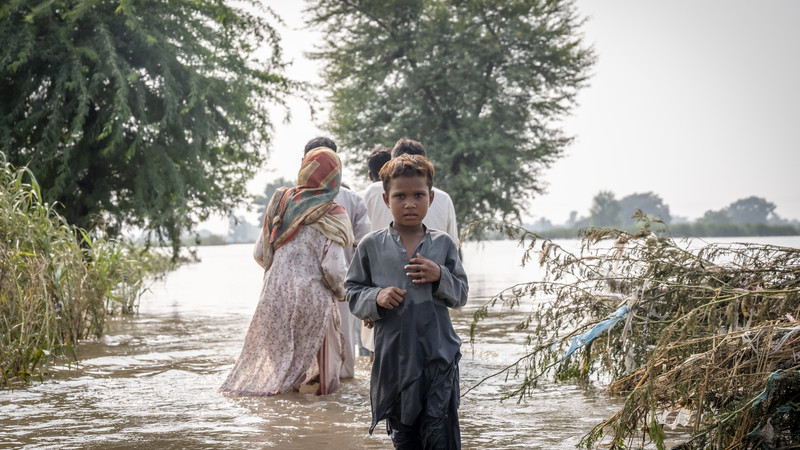
In Pakistan, when flood alerts hit Punjab at the end of August 2025, early warnings were provided to schools in districts like Muzaffargarh and Rajanpur, triggering action. Teachers and school management committees preserved school records and learning materials in pre-identified safe spaces. They activated flood-adaptive learning plans, moved furniture, and informed parents about the relocation of schools to support continuity of learning. In particularly flood-prone schools school staff laid sandbags to protect schools from flooding and associated damage.
These actions are what anticipatory action for education can look like: assistance at small and large scales to allow children to continue learning in the face of extreme weather events.
The problem we’re solving
The Geneva Global Hub for Education in Emergencies’ 2025 Flagship report ‘Acting Ahead to Protect Education Investments – Why the need for proactive approaches to crises is more urgent than ever’ sets out how the right investments ahead of crises can save both lives and resources, while protecting the education and futures of millions of children and youth. Crises may be unavoidable, but their worst impacts are not.
In 2024, ECW set up Anticipatory Action pilots in Pakistan and Somalia. These were intended to test and learn about effective Anticipatory Action in education in emergency situations. These pilots were essential investments after the widespread effects of El-Niño in Somalia. Similarly, Pakistan’s 2022 floods submerged a third of the country and affected an estimated 33 million people. Education was heavily impacted: over 17,000 schools were damaged or destroyed (Post-Disaster Needs Assessment 2022). This affected over 2.6 million school-age children, with overall recovery and reconstruction needs of US$918 million.
Using Forecasts and Working with Uncertainty
Anticipatory action (AA) means taking pre-agreed, pre-financed steps informed by climate and weather forecasting before a hazard hits, using triggers to act early. In education, that can mean protecting school assets, preparing rapid transitions to safe temporary learning spaces or remote modalities, and getting students back to school faster. It’s not a substitute for disaster risk reduction (DRR) or post-disaster responses, but an additional mechanism that can better equip families, schools and communities to withstand extreme weather events. Evidence from the emergencies sector suggests Anticipatory Action interventions are generally more cost-effective than traditional, post-shock responses, often achieving returns on investment 1.5-2 times greater. Anticipatory Action has shown that households are less likely to resort to harmful strategies during crises, such as pulling children out of school.
ECW’s Anticipatory Action Pilot in Pakistan
A year ago, ECW announced funding for an Anticipatory Action pilot in six flood-prone districts across Sindh and Southern Punjab, delivered by UNICEF and Save the Children and in close coordination with federal and provincial disaster management authorities, hydromet agencies, and provincial and district education departments.
The aim: to minimize learning disruption during riverine floods, reduce drop-out and the number of missed school days, provide learning continuity, and protect education investments and infrastructure by acting on forecast-based triggers.
We built on what already exists in Pakistan for riverine flooding, aligning to the pre-agreed thresholds already in place and monitored by entities such as START Network, Food and Agriculture Organization and Pakistan’s National Disaster Management Agency. Our education pilot complements this ecosystem: we didn’t reinvent the wheel—we focused on aligning school-level actions with national triggers and district operations, ensuring that last critical link in the chain from district to school level is strong.
How the Anticipatory Action pilot works in practice
- Define the risk: prioritize districts at risk of extreme riverine flooding where coordinated Anticipatory Action is taking place in other sectors.
- Agree triggers & thresholds: use government flood forecasts and gauge data to set thresholds at which schools move to “ready” and “activate.”
- Pre-position actions & finance against an agreed plan: stock waterproof storage and school protection materials; prepare messaging for teachers, parents and students, pre-agree temporary learning sites and alternative learning provision.
- Drill & train: short simulations with headteachers, SMCs/PTAs, and local officials
- Activate quickly: when thresholds are met, give the green light, move assets, secure facilities, stand up temporary or remote learning, and provide catch-up plans—within 48–72 hours.
This monsoon season: what we did and didn’t do
Forecasts this year pointed to worse-than-usual monsoon risks in parts of Pakistan. ECW and partners in country used weekly check-ins to ensure readiness, government-led school selection, and short, practical training. The heavy rains triggered flash floods in northwest Pakistan which were not covered by the anticipatory action. This reminded us of the importance of having comprehensive early warning systems covering all hazard types, especially for difficult to predict ones such as flash floods. However, in Punjab and Sindh, thresholds for riverine flooding were met, and we activated. Through the pilot, we will document time-to-resumption and attendance impacts. Through pilots like these, gaining clarity on when to act and when not to helps to focus resources.
Riverine floods build over days from upstream flow—great for forecast-triggered activation. Flash floods rise in hours from localized intense rain—needs a different trigger and often there isn’t enough time to activate Anticipatory Action. |
The impact of acting early on education
- Days of learning preserved by protecting school assets and having a plan for learning to continue.
- Faster, safer reopening due to pre-identified temporary sites and transport options.
- Lower drop-out risk, especially for girls, by maintaining contact, providing menstrual hygiene supplies, and safe learning spaces.
Contributing to a learning agenda
- Our pilots are designed to benefit the whole sector. Alongside these interventions, we are partnering with Tufts University to document:
- The process: the components of an education Anticipatory Action framework (triggers, roles, finance, actions), the design and activation and how this could be strengthened.
- Impact: comparing schools/children covered by Anticipatory Action with similar schools/children outside activation zones—looking at time-to-resumption, attendance, asset loss, and cost per child compared to response costs. This will help to see if Anticipatory Action in education is truly better value for money and whether a financial case can be made for future similar investments.
- Protection, gender & inclusion: which early actions most reduce drop-out for girls and learners with disabilities? How safe did children feel when their learning was disrupted due to flooding?
What we need next – in Pakistan and beyond
- Continue to build an early action mindset: Anticipatory Action should be part of crisis readiness planning in all climate vulnerable contexts. Alongside the pilot in Pakistan, ECW also has Anticipatory Action investments in Somalia and Afghanistan and is looking to grow this type of investment.
- Continue to build expertise in the sector: These pilots should help the education in emergencies community learn and build expertise on how to set up and implement effective Anticipatory Action, alongside other emergency support. Building on the Global Education Cluster guidance and Anticipatory Action task team, earlier this year the Global Education Cluster, together with ECHO and ECW brought together all education partners working on Anticipatory Action to share experiences and create opportunities for peer-to-peer action learning. This helped partners exchange on how to prioritize, when to implement different kinds of activities, what to measure and track, and what works best for particular hazards.
- Financing at scale: There is an ongoing need for flexible, pre-arranged envelopes earmarked for coordinated Anticipatory Action and crisis readiness. ECW’s pilots will help inform areas and points in time where funding could be best utilised in Anticipatory Action for education and pre-positioned to do such work at scale. These anticipatory action and education programmes also show concrete ways schools and education systems can be an important area of action to respond to loss and damage ahead of extreme weather events. At COP30 the Fund for Responding to Loss and Damage opened its country level call for proposal and ECW encourages its partners to push for education in this important project initiation phase
- Evidence: Through our learning work, we are striving to examine Anticipatory Action’s positive impact on children, its cost-effectiveness, and the importance of promoting equity. This is critical in a resource constrained environment and a key part of the humanitarian reset.
More featured content