

Out of the Shadows and Into the Light
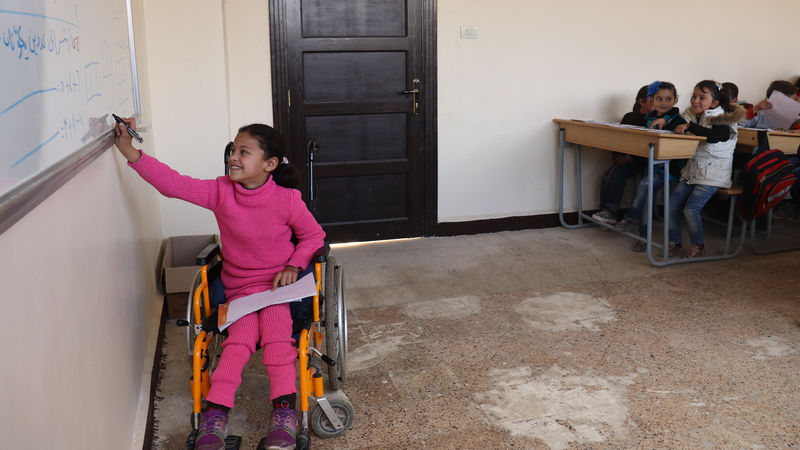
‘more than 1 billion people in the world live with some form of disability. In many societies, persons with disabilities often end up disconnected, living in isolation and facing discrimination.’ – message from the secretary general on the international day of persons with disabilities.
By Aida Orgocka
“If you are a girl, 11 years old, and disabled, you may not as well exist.” It was a blunt comment to my remark that I did not see any disabled children in the schools I visited last week in two refugee settlements in the West Nile region in Uganda.
Worldwide, one in every 10 children has a disability – and the proportion is even higher in areas with armed conflict, protracted crises or disasters. But, unless we ask about them, they are invisible. Cut off from the world, cut off from their education, play and laughter. Children with disabilities are perhaps the least serviced community when it comes to providing inclusive, accessible, reliable and safe access to education for children living in crisis.
Education Cannot Wait is investing to reverse this phenomenon. Making a difference in the lives of disabled children living in crises can be challenging, but it should not stop us from doing it. As part of a global movement to bring education to all vulnerable children living in crises, we are investing in solutions to make a positive change and pull disabled children out of the shadows and into the light.
DISABILITY IS REVERSIBLE
Impairment can be a lot of irreversible issues, congenital, an illness, an injury. But disability is about inaccessible environment, discrimination, poverty, lack of opportunities, all human made. And it can be reversible.
Having said that, the reality of living in a refugee or displacement camp or in the midst of crisis can be harsh. Most disabled children in crises settings live in tough places – rough terrain, no electricity, distance to travel to access water, few ill-equipped schools, limited access to health services. Even healthy children struggle to survive, to access education, to find toys to play with, and to find hope. For girls, it’s even harder. Now imagine being a girl in a wheelchair?
For this girl – and the millions more like her – accessing education is extremely difficult.
Let’s start with the basics. If you are in a wheelchair and live in a displacement camp in Uganda way out in the countryside by the border with South Sudan, just getting to school is a challenge. Most wheelchairs and accessibility devices are ill-equipped for this rough terrain. And wheelchair ramps? Forget about it.
Let’s say, however, that your parents overcome the stigma of having a disabled child and figure out a way to get you to class. From there, you risk facing the brutality, bullying and ridicule of your peers – children can be pretty tough on their peers sometimes, especially if there are no measures in place to address discriminatory attitudes and behaviors.
In one of the refugee settlements in Uganda, some teenage refugee boys from South Sudan suggested we could get them bicycles and they would ride children with disabilities to school. Sure, I thought, great idea.
But they added that they would rather these kids be set apart in different classrooms. They felt that in these already congested classrooms with more than 50 students vying for the teacher’s attention, they would be left out.
This is a real challenge. In fact, teachers in these settings are undertrained, underpaid and ill-equipped to deal with students with disabilities. Sometimes their own knowledge, attitudes and beliefs towards disability are also part of the problem.
We have a problem of stigma, a problem of access, a problem of capacity. So how do we deal with it?
A WHOLE-OF-SYSTEM APPROACH
This is what people call a wicked problem. And the only solution to wicked problems are courageous solutions, not one-off stints. That means a whole-of-system approach.
We can’t just give children souped-up wheelchairs. We have to create behavior change across society, and we have to engage with all the actors across the human-development-education-emergency-response field to create integrated solutions.
Our friends at UNICEF have been working on this problem for a long time. Some solutions are presented in their guidance on Children Living with Disabilities in Humanitarian Crisis.
In order to do this, Education Cannot Wait is investing in programs that mainstream gender equality and equity including disability. We collectively work to make inclusive quality education a reality for disabled children. They cannot be an after-thought.
Inclusive education is a government policy in Uganda. As one colleague remarked deliberate efforts for inclusive education come with a cost but this should not deter us.
In the refugee settlements in Uganda it starts with understanding and creating a culture of inclusion. To push this, teachers (our frontline ambassadors for engagement with children with disabilities living in crisis), need to be sensitized to the value of inclusion, need to be trained on dealing with children with special needs and need to be given the tools they need to address the issue.
Yes, engaging with parents and communities is important, but let’s not forget to make young girls and boys key agents of change. What a wonderful world it would be to see a child biking with a friend with a disability to school and sharing notes as they prepare for school exams!
And how about inviting organizations that provide disability services to sit in the same aid coordination fora with those who specialize in providing education services? They would have so much to say about what inclusive education is and how to help children with disabilities live a normal life.
No matter how we look at the problem, as we connect to reach the Sustainable Development Goals for inclusion, universal access to education and peace, it is certainly clear that we need to take immediate action. One-off responses are no longer enough, we need a collective response to ensure that being in a wheelchair, developmentally challenged or having special needs is not a sealed fate. No girl or boy living in crises should be left behind.
About the Author
Aida Orgocka is the Gender Advisor for Education Cannot Wait.
More featured content