

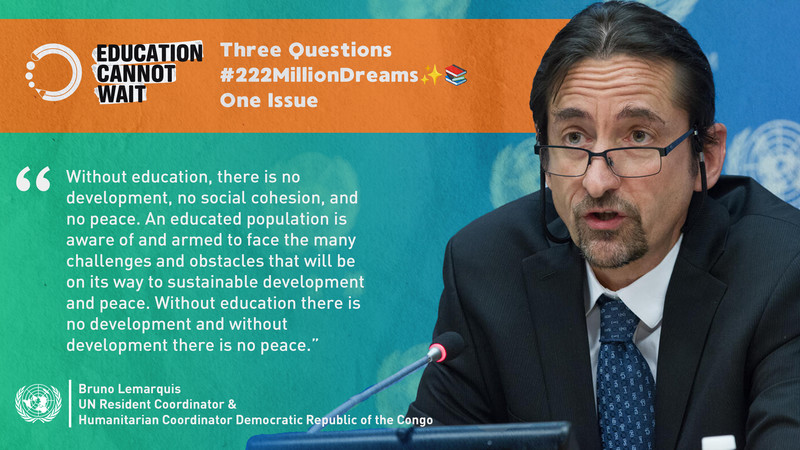
Three Questions, #222MillionDreams✨📚; One Issue: Education and the ‘Triple-Nexus’ with UN Resident Coordinator & Humanitarian Coordinator DRC, Bruno Lemarquis
Q1: The Democratic Republic of the Congo (DRC) faces one of the most long-standing, complex protracted crisis on the globe. In such a context, how important is it for aid stakeholders to support the education sector among the multitude of urgent priorities in the country? Why must education be a leading priority?
"Education is the most powerful weapon you can use to change the world", says the proverb. To deprive children of their education is to deprive oneself of an excellent tool for emancipation and personal development. Without education, there is no development, no social cohesion, and no peace. An educated population is a population that is aware of and armed to face the many challenges and obstacles that will be on its way to sustainable development and peace. Without education there is no development and without development there is no peace.
We have experienced that support to education can contribute to peaceful cohabitation between communities that can be affected by inter-community conflicts, as their children are called upon to attend together the schools we have supported. At these schools, children learn moral values and this can lead to sustainable solutions as the school shapes generations that can live together without discrimination.
Q2: The UN system works with the Government and partners to strengthen complementarity and coherence between emergency relief, development, and peacebuilding efforts - the ‘triple-nexus’ - in Tanganyika Province, DRC as the region gradually becomes more peaceful. As part of these efforts, ECW funding supports UN, civil society, and local community partners to jointly deliver holistic education programmes to vulnerable girls and boys. Can you explain what this “triple nexus” means in the DRC, how it translates into action and why it is so important?
The whole nexus approach is an approach based on the search for durables solutions, by addressing vulnerabilities and tackling causes, including structural causes, which I like to call the Gordian knots. In many conflict-affected countries and fragile states, most of the efforts, investments, aid, go towards the symptoms, the effects, the consequences. And year after year, the same things are repeated. But the same recipes will not have different results. A prolonged, chronic humanitarian crisis has causes. Let's look for them, let's try to understand them, let's have a common understanding, with development, peace, human rights, and humanitarian actors together. Once we have found the causes, what are the best remedies, or the paths to the remedies. A land problem? A problem of access or distribution of resources? A problem of identity, of justice? Extreme poverty? the list can be long, but it is important to name the problem(s) and then work with the right actors, with an inter-disciplinary approach because problems are usually intertwined. Two issues we will work on with this approach are, for example, chronic food insecurity and durable solutions for internally displaced people, including in the Tanganyika province for the latter.
Q3: You recently stated “We need more instruments like Education Cannot Wait”, noting that ECW operates with humanitarian speed and achieves development depth in crises. This is an important acknowledgement and recognition of ECW’s work in the UN and of multilateral systems operating in crises contexts. Could you elaborate further on your statement, particularly the why and the how?
Development should almost never stop. Because we should always do our level best to help people get back on their feet and get on with their lives. Always do our level best to get local systems, including public services, running and the local economy back on stream. In crisis context, we can call it emergency development. To avoid falling into the humanitarian dependency trap, which can hurt people’s dignity and sometimes induce harmful behaviours and practices. So, everything that can be done to help with this, with a development lense – agriculture cannot wait; health cannot wait; job creation cannot wait; business development cannot wait; building a house cannot wait – should become part and parcel on our way of thinking and way of working. This is also the nexus at work.
More featured content