

Education Cannot Wait Interviews Henrietta H. Fore, UNICEF Executive Director
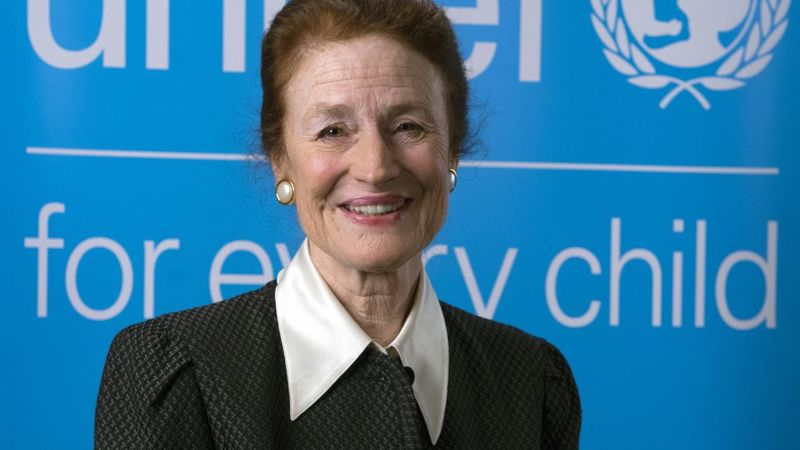
Henrietta H. Fore became UNICEF’s seventh Executive Director on 1 January 2018. She has worked to champion economic development, education, health, humanitarian assistance and disaster relief in a public service, private sector and non-profit leadership career that spans more than four decades.
From 2007 to 2009, Ms. Fore served as the Administrator of the U.S. Agency for International Development (USAID) and Director of United States Foreign Assistance. The first woman to serve in these roles, she was responsible for managing $39.5 billion of U.S. foreign assistance annually, including support to peoples and countries recovering from disaster and building their futures economically, politically and socially.
Earlier in her career at USAID, Ms. Fore was appointed Assistant Administrator for Asia and Assistant Administrator for Private Enterprise (1989-1993). She served on the Boards of the Overseas Private Investment Corporation and the Millennium Challenge Corporation. In 2009, she received the Distinguished Service Award, the highest award the Secretary of State can bestow. Read full bio >>
ECW. Before we talk about education, can you tell us how UNICEF is responding to the current COVID-19 pandemic?
Henrietta H. Fore. In just a few months, COVID-19 has upended the lives of children around the world. It represents not only a threat to their health — but to their education, as schools close their doors worldwide, and to their safety, as the combined socio-economic impacts of job losses, isolation and containment measures put children at increased risk of abuse, exploitation and violence. In communities worldwide, you can find UNICEF staff members working around the clock to provide emergency education kits, distance learning opportunities, lifesaving information about handwashing and sanitation, and psychosocial counselling to affected children. We are also working with governments to strengthen health systems, and better manage the disease as the outbreak spreads. We are sparing no effort to give this global health emergency the attention and resources it deserves.
In just a few months, #COVID19 has upended the lives of children around the world. Hundreds of millions are not in school. Parents and caregivers have lost their jobs. Borders have been closed. https://t.co/IMk7gjgCmw
— Catherine Russell (@unicefchief) March 25, 2020
ECW. You have served all your life leading and championing humanitarian and development issues, not the least education. What drives you?
Henrietta H. Fore. I’m driven by the futures of children. Everywhere I travel, even in the most difficult circumstances — in conflicts and natural disasters, in communities plagued by extreme poverty or discrimination — I meet children and young people whose eyes and faces are lit with hope for the future. They tell me about their dreams and aspirations. They want to contribute to their families and economies. Even those living in the most difficult circumstances are not passive victims. They are determined to build their own futures. But they need the right tools and support. Providing quality education to every child in every context is not only a basic human right — it is essential to bringing their dreams to life and to sustaining progress and even peace for all of humanity in the future.
ECW. What is the scale of the current crisis, and how does it relate to our collective efforts to reach SDG 4?
Henrietta H. Fore. The Sustainable Development Goals’ call for “education for all” must mean exactly that — education for all. Even those children whose education is interrupted by, or non-existent because of, conflicts and natural disasters. As Education Cannot Wait reminds us, there are currently about 75 million children in urgent need of educational support across 35 crisis-affected countries. In fact, the countries furthest away from achieving SDG 4 are all crisis-affected. In other words — we will not reach this goal if we fail to reach precisely these children. In these humanitarian emergencies, children’s education suffers first, when schools are closed or destroyed, and education is interrupted. Also, they are especially vulnerable to abuse, trafficking and exploitation. We must never forget that a generation of young people is at stake — tomorrow’s leaders, tomorrow’s citizens, tomorrow’s caretakers of our world. We cannot afford to let them down — at any stage of their education, no matter what barriers we must overcome to reach them.
ECW. UNICEF oversees multiple sectors and is the lead agency on education in emergencies. Why is delivering education in emergencies so important – as important as water, nutrition, medicine and other services? Why is it important to recognize education as a lifesaving intervention at times of humanitarian crisis?
Henrietta H. Fore. A child’s right to an education does not change because of a crisis. In fact, it is just important as every other need, and can even improve outcomes in other sectors. For example, schools provide a place for children to learn more than reading and math. They also learn healthy behaviours, such as the importance of proper nutrition and hand-washing to prevent disease. Schools also create a safe and secure learning environment during times of insecurity and crisis, providing a needed sense of normalcy, continuity and safety for children that have seen and experienced often traumatic events. So education not only provides a pathway for children to build and fulfil their potential — it can have multiplier effects that can help young people stay safe and healthy.
ECW. We have recently witnessed important steps to present a consolidated UN response to the wellbeing and education of children caught in emergencies and crises. How do you see the role of UNICEF in strengthening co-ordination between relevant UN partners, civil society and private sector to ensure continuity, inclusion and real learning in complex emergencies?
Henrietta H. Fore. UNICEF is uniquely placed to bring partners together to serve children living through emergencies. We have over 790 education staff members spread across 144 countries — the single-largest global education presence of any international agency. This deep presence allows UNICEF to help countries expand access to quality education, even for the most marginalized children, such as those young refugees fleeing conflicts across borders. UNICEF is also the largest provider of education in emergencies in humanitarian response and, together with Save the Children, we are leading an IASC cluster co-ordination group on education. Together, we are working to ensure that all of our national and global partners are working as one to deliver quality education to children in emergencies.
ECW. UNICEF hosts a number of global funds and initiatives, including the Education Cannot Wait Fund. As a member of Education Cannot Wait’s High-Level Steering Group, how do you see Education Cannot Wait’s contribution to advancing SDG4 in crisis situations?
Henrietta H. Fore. Initiatives like Education Cannot Wait are gathering partners around the urgent and complex needs of children facing some of the world’s worst realities. ECW’s financing efforts are particularly important, enabling partners on the ground to act quickly to fill the gap between humanitarian and development funding, while building stronger school systems for the future. This is critical, especially when we consider that only about two per cent of overall humanitarian funding is currently dedicated to education. We must work to ensure that we use ever dollar for education wisely and strategically, while at the same time turning up the volume on this education emergency to draw even more funding and resources.
ECW. A major priority is that of girls’ education, especially for girls left furthest behind in conflicts, natural disasters and forced displacement. How can we reach these girls by 2030? How can we accelerate our joint efforts during the Decade of Action?
Henrietta H. Fore. On this issue, we cannot be complacent. Despite progress, 130 million girls are still out of school around the world. Even those who gain a primary education are still vulnerable to dropping out and being unable to continue their education beyond that level. And many girls who finish primary school are contending with poor quality education, and will not meet minimum proficiency in reading by the time they finish. This is not only an injustice — it’s a huge missed opportunity for development. Educating girls not only combats poverty, it also ensures better maternal and child health. That’s why UNICEF is bringing together partners around solutions like flexible learning for girls trapped by crises, and investments in school facilities — like separate toilets and safe learning spaces — to keep them learning. The Decade of Action depends on accelerating our progress through efforts like these, and we will not stop until every girl gets the education she needs and deserves.
ECW. As an inspirational global leader, what is your message to children and youth, many of whom you have met, who dream of an education, as they suffer the brunt of conflicts and disasters?
Henrietta H. Fore. My message to them is simple: education can never be taken from you. It is yours. It is portable. It will give purpose to your hands, hearts and dreams, wherever you may travel. Even as you face these crises and disasters, remember that millions of people are standing with you in your hour of need — donors, governments, activists, organizations like UNICEF, partnerships like Education Cannot Wait, NGOs, businesses and community leaders. Together, we are working around the clock to design, fund and deliver programmes to ensure you have the tools you need to shape your minds and your futures. We will not leave you behind.
Social Media
Working from home, day 8. Today, I launched the #COVID19 Global Humanitarian Response Plan with @antonioguterres, @DrTedros and @UNReliefChief.
— Catherine Russell (@unicefchief) March 25, 2020
With unity and more support, we can meet the critical needs of the most vulnerable. We are counting on you. #WeAreOne pic.twitter.com/tCXWvYr9ud
More featured content