

Education in an Age of Displacement
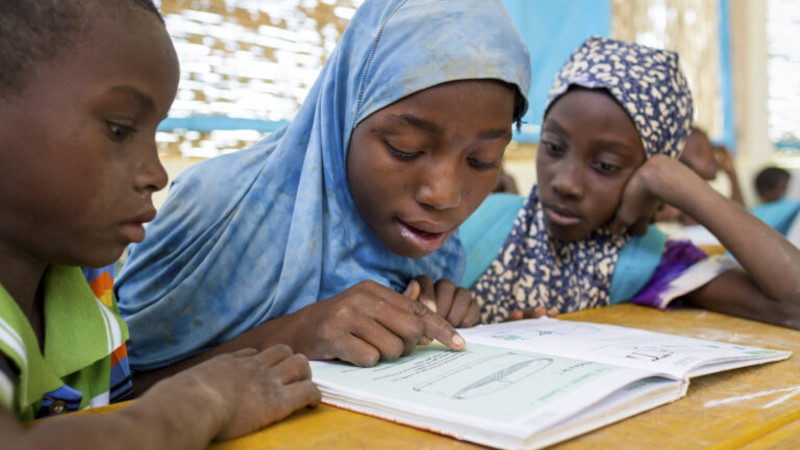
With the number of displaced people on course to double by mid-century, if not sooner, developing their potential is crucial. Extending hope and opportunity to young people at risk of being left behind is a powerful way to advance human rights, promote equality, and foster peace and stability.
By Gordon Brown and Allan Goodman. Article re-posted with permission from Project Syndicate.
5 October 2021, London – The ongoing flood of refugees from Afghanistan – now some 2.6 million strong – is sadly no isolated tragedy. Indeed, if all of today’s 82.4 million refugees and forcibly displaced persons were gathered into a single state it would be the world’s twentieth largest country by population. If current trends continue, and climate change adds substantially to the numbers as the World Bank predicts, the number of refugees and displaced persons by mid-century could exceed the population of Brazil, and nearly that of Germany, Italy, the United Kingdom, and France combined. With sea levels rising, some forecasters suggest that the world’s displaced population – already the largest recorded in human history – could exceed one billion.
Long before we heard anything about a novel coronavirus, the rising number of refugees was being driven by the pathogens of war and ethnic and religious hatred, and by our collective inability to feel others’ pain. Refugee “camps” have become permanent cities, but most refugees are dispersed in hovels, huts, and rented accommodation, where they have been living for almost 20 years on average, with no end in sight.
Tragically, among the millions suffering from this disruption is a lost generation of young people with little access to education and employment. Think of the talent that would be lost, the ability squandered, and the potential untapped if a country’s entire youth population was denied these opportunities.
Among today’s displaced youth are potential leaders – the future Albert Einsteins, Jessye Normans, J.K. Rowlings, and Tim Berners-Lees – with the capabilities and drive to make the world a more prosperous and less dangerous place. But what chance is there for a young person trapped in a besieged town in Syria or Afghanistan to show their genius? Or for a child in the midst of the conflict in Yemen, Chad, the Central African Republic, Cameroon, or Libya, or in the South Sudanese refugee camps on the Ugandan border?
The refugee problem is now so widespread that even in wealthy Europe, thousands of young people in the Moria camp in Greece – until it burned down in 2020 – were receiving no formal education. Two summers ago, three adolescents in Moria – aged 12, 13, and 14 – reached such levels of despair that they attempted suicide.
Yes, hope dies when a refugee boat capsizes, a food convoy can’t reach hungry people, and a hospital has no doctors to treat patients with COVID-19. But hope also dies when a young person cannot prepare for the future and is unable even to dream of a different life. This happens when they are denied the education all young people need to bridge the gap between who they are and what they can become.
There is no single-shot vaccine that will end the exploding refugee crisis. But amid the chaos, efforts are underway to provide life-changing educational opportunities to young people currently living without the advantages of more stable, supportive environments.
For school-age refugee children and youth, new hope dawned in 2016 with the launch of Education Cannot Wait, a United Nations global fund. Since its inception, the initiative has not only reached an estimated 4.6 million children trapped in some of the world’s worst humanitarian crises, but it has also acted as the catalyst for aid agencies to help millions more.
For university-age students, the Institute of International Education’s online Platform for Education in Emergencies Response offers pathways to continue formal and informal higher education. These include the University of the People, a tuition-free online university accredited in 2014 that counts 7,000 refugees among its 106,000 students. The university has promised the United Nations that it will enroll 25,000 refugee students by 2030.
We now need to expand the circle of opportunity by providing a similar opportunity at the graduate level for refugee and displaced students. That means building the equivalent of the Fulbright, Churchill, or Marshall programs, which have found and developed individual talent for decades.
Such scholarship programs do much more than that. The Harkness Fellowships have built a collaborative international network of health-policy researchers and practitioners. The Kennedy Scholarships spur closer transatlantic relations between future leaders. The Schwarzman Scholars are forging a network that will foster stronger ties between China and the rest of the world. The Mandela Rhodes Scholarship is equipping young Africans to become visionary leaders who will transform the continent and advance equality, freedom, and human rights. Extending hope and opportunity to young people at risk of being left behind is a powerful way to advance these values, foster peace and stability, and bring about a transformative and durable solution to the refugee crisis.
We know that we can find young potential leaders among the most disadvantaged group of all – the displaced – and give them access to advanced education. An innovative, competitive program would provide refugee and displaced students with fellowships for two full years of graduate study, in any field, within the country where they have found refuge or anywhere in the world. If this initiative can attract the funding it needs to be successful, it will take its place alongside other respected, enduring, and high-impact scholarship programs, and, like them, over time it will take thousands of young people from where they are to what they can become.
More featured content